
















Lactate is no longer the enemy: the molecule that is changing sports and health
For years they told us a story... today we know that it was incomplete
If you practice sports, You have probably heard phrases like:
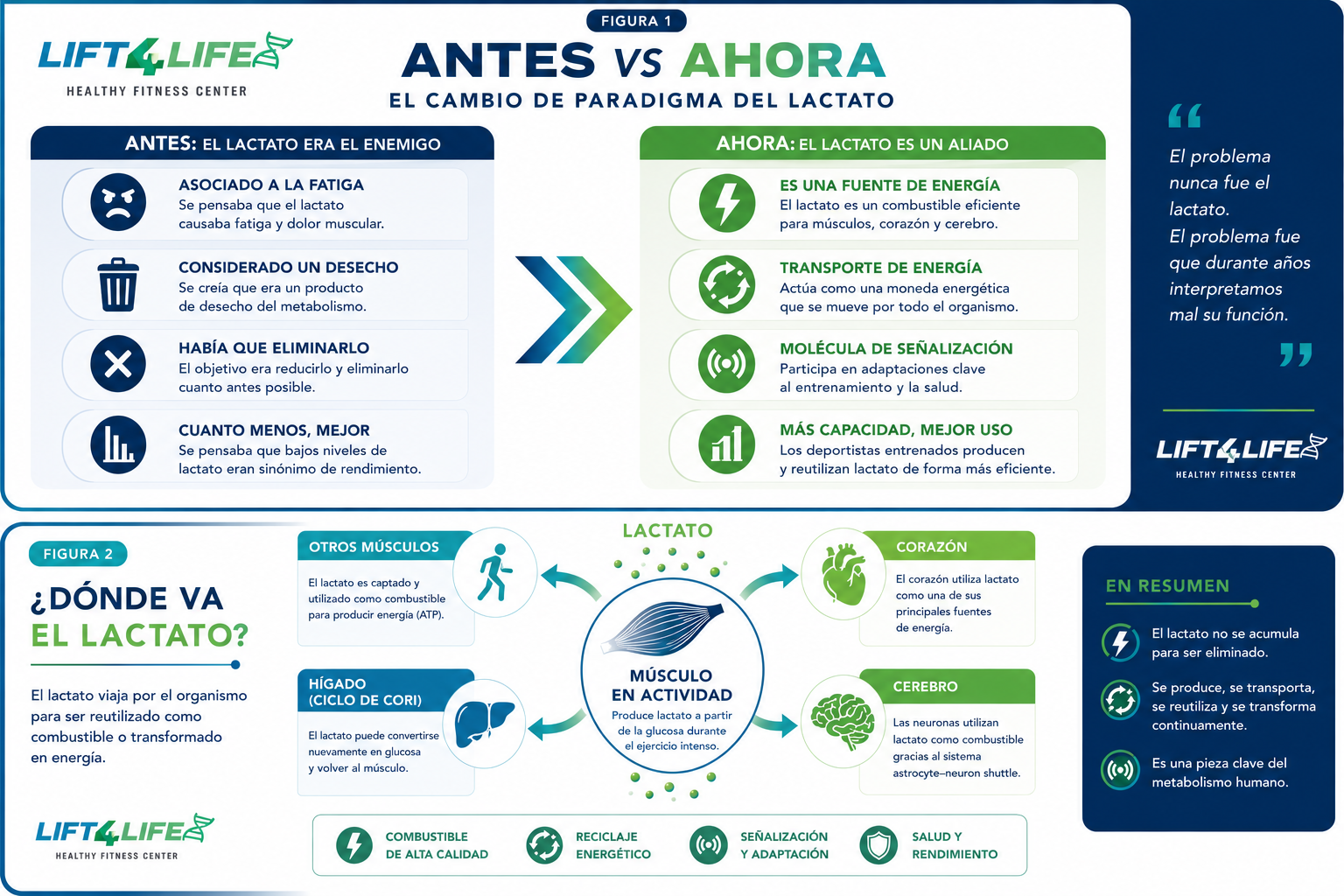
- ❌ “Lactate causes fatigue.”
- ❌ “Lactate must be eliminated as soon as possible.”
- ❌ “It is a waste product.”
- ❌ “The less lactate, better.”
For decades these statements were part of physiology and training books. However, scientific evidence has completely changed this view.
Today we know that lactate It is not a waste, but a fundamental molecule to produce, transport and reuse energy during exercise.
Much of this paradigm shift is due to research by George Brooks, Lee Gladden e Inigo San Millan, who have contributed to transforming our understanding of lactate metabolism.
So much so that recently some elite athletes, as Tadej Pogačar, have generated great interest by using lactate-related strategies during competition.
But the real news is not that.
The real news is that lactate was never the enemy we thought.
What really is lactate?
When we exercise, our body uses glucose to produce energy (ATP).
During this process, it is generated lactate, even when there is enough oxygen.
That is to say:
✅ Lactate It does not appear because there is a lack of oxygen.
✅ Lactate It doesn't mean the muscle is failing..
✅ Lactate is produced continuously, even at rest.
Its main function is to allow the body to continue producing energy efficiently when demand increases..
The great paradigm shift: el Lactate Shuttle
One of the greatest advances in exercise physiology was the theory of Lactate Shuttle, developed by the teacher George Brooks.
His theory demonstrated that lactate was not a metabolic waste, but a molecule capable of transporting energy between different tissues.
👉 A tissue produces lactate.
👉 Other fabric uses it as fuel.
In other words, Lactate works as a true energy currency that the body continually moves to where it is most needed..
years later, researchers like Lee Gladden e Inigo San Millan expanded this knowledge, demonstrating the importance of lactate in sports performance, mitochondrial function and metabolic health.
Lactate is not eliminated… it is reused
Today we know that much of the lactate produced during exercise is used again a few minutes later.
Can be consumed by:
- 💪 Other muscles.
- ❤️ The heart.
- 🧠 The brain.
- 🫀 It can even be transformed back into glucose in the liver.
That is to say, the body constantly recycles that energy instead of wasting it.
The heart and brain also use lactate
One of the most interesting discoveries in recent years is that lactate not only fuels muscle.
❤️ The heart
During intense exercise, the heart considerably increases its consumption of lactate, making it one of its main sources of energy.
🧠 The brain
The brain can also use lactate as fuel, especially when your energy needs increase.
This has sparked enormous interest in neurology and is driving new lines of research into brain injury., stroke and neurodegenerative diseases.
Although it is still early to talk about clinical applications, the results are very promising.
Much more than energy
Perhaps the most surprising discovery is that lactate not only provides energy.
In addition to serving as fuel, Recent research has shown that lactate also acts as a signaling molecule capable of regulating fundamental cellular processes, participating in processes such as:
- Formation of new mitochondria.
- Development of new blood vessels.
- Adaptation to training.
- Regulation of gene expression (histone lactylation).
That is to say, lactate not only helps produce energy.
It also helps the body adapt to exercise.
Does it make sense to supplement with lactate?
For years we thought it was a waste product. Today we know what a fuel is, an energy transport molecule and a regulator of multiple physiological adaptations.
Thanks to the work of researchers such as George Brooks, Lee Gladden e Inigo San Millan, We understand that lactate is not the enemy of performance, but a key piece of human metabolism.
The hypothesis is interesting:
If the body uses lactate as fuel, could it be managed to improve performance?
Although some elite athletes are already experimenting with this strategy, scientific evidence is still limited.
Today We cannot say that lactate supplementation consistently improves performance..
What we do know for sure is that lactate is not an enemy.
The key idea
For years we tried to eliminate lactate.
Today we try to understand it.
Science has shown that this molecule:
- ✅ It is a fuel.
- ✅ Transports energy between tissues.
- ✅ Participate in training adaptations.
- ✅ May have medical applications in the future.
Ultimately, Lactate has gone from being considered a metabolic waste to becoming one of the most fascinating molecules in human metabolism..
And we probably still don't know its full potential.
Do you want to train with a science-based approach?
👉 Find out how we can help you: https://www.lift4life.es/
References
- Brooks G. A. (2018). The Science and Translation of Lactate Shuttle Theory. Cell metabolism, 27(4), 757–785. https://doi.org/10.1016/j.cmet.2018.03.008
- Gladden L. B. (2004). Lactate metabolism: a new paradigm for the third millennium. The Journal of physiology, 558(Pt 1), 5–30. https://doi.org/10.1113/jphysiol.2003.058701
- Brooks G. A. (2020). Lactate as a fulcrum of metabolism. Redox biology, 35, 101454. https://doi.org/10.1016/j.redox.2020.101454
- Zhang, D., Tang, Z., Huang, H., Zhou, G., Which, C., Weng, Y., Liu, W., Kim, S., Lee, S., Perez-Neut, M., Ding, J., Clean, D., Hu, R., Ye, Z., He, M., Zheng, Y. G., Shuman, H. A., Dai, L., Ren, B., Roeder, R. G., … Zhao, Y. (2019). Metabolic regulation of gene expression by histone lactylation. Nature, 574(7779), 575–580. https://doi.org/10.1038/s41586-019-1678-1
- San-Millán, I., & Brooks, G. A. (2018). Assessment of Metabolic Flexibility by Means of Measuring Blood Lactate, Fat, and Carbohydrate Oxidation Responses to Exercise in Professional Endurance Athletes and Less-Fit Individuals. Sports medicine (Auckland, N.Z.), 48(2), 467–479. https://doi.org/10.1007/s40279-017-0751-x
Made by: Alvaro Gallego (trainer and trainer at Lift4Life)